
Rolex 2026 New Watch Perpetual Padellone: When Annual Calendar Meets Moonphase
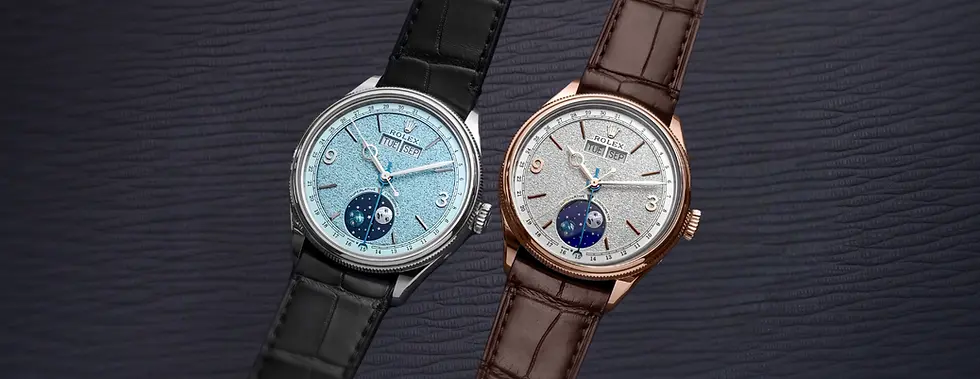
In September 2026, the Rolex Perpetual collection welcomed the new Padellone. With an annual calendar, a meteorite moonphase display and the calibre 7190 movement, it reinterprets the classic calendar watch, Ref. 8171. The day, month, date and moonphase are neatly arranged, inviting you to take another look at the dial even after checking the time.
Padellone: A Name Given by Collectors
Padellone means “large frying pan” in Italian, a nickname collectors gave the vintage Rolex Ref. 8171 for its generously sized case. Combining a complete calendar with a moonphase display, Ref. 8171 serves as the inspiration for the Perpetual Padellone. The new model’s day and month windows, date scale around the dial and moonphase display follow the familiar layout of traditional calendar watches.
Rich in Information, Surprisingly Clear
One of the greatest challenges in creating a calendar watch is not how many functions it offers, but how clearly it presents so much information within a limited space.
The Perpetual Padellone gives each display its own position, keeping the dial from feeling crowded. Two windows at 12 o’clock show the day and month in English. Instead of placing the date in a third window, Rolex arranges it around the outer edge of the dial, indicated by the crescent-shaped tip of a blue hand. The moonphase display occupies the six o’clock position.
Most of the dial features a finely grained texture, while the outer edge has a satin finish. These contrasting finishes create distinct areas for the day, month, date and moonphase. Despite the amount of information on display, the dial remains intuitive and easy to read.
A Moonphase Display Made with Meteorite
The moonphase display at six o’clock is one of the Perpetual Padellone’s most intriguing details. It recreates the changing phases of the moon, from new moon through first quarter and full moon to last quarter. A deep blue enamel disc completes one rotation every 29.53 days, corresponding to a lunar cycle.
Both the full moon and new moon on the disc are made from meteorite, with the new moon receiving an additional deep blue PVD treatment. The silver stars are applied using pad printing. Rolex has previously used meteorite for its dials, but incorporating material from space into an astronomical complication adds another layer of collector appeal to the Perpetual Padellone.

Annual Calendar and Perpetual Calendar : What Is the Difference?
The word “Perpetual” may bring a perpetual calendar to mind, but here it refers to the name of the Rolex Perpetual collection. The Padellone is equipped with an annual calendar. Its Haplos system distinguishes between months with 30 and 31 days. As long as the watch keeps running and the calendar is correctly set, it requires just one adjustment each year, at the end of February as March begins. A perpetual calendar goes further, accounting for February’s varying length and leap years.
Another detail worth noting is the instantaneous change at midnight. The Padellone’s day, date and month displays jump together whenever a change is due, completing the transition in a fraction of a second with crisp mechanical precision.
The Modern Calibre 7190 Beneath a Classical Exterior
The new Rolex calibre 7190 self-winding movement is based on the design of calibre 7135 used in the Land-Dweller. It features the Dynapulse escapement, operates at 5 Hz, equivalent to 36,000 vibrations per hour and offers a power reserve of approximately 66 hours.

The Padellone’s Place in Modern Rolex
The Perpetual Padellone continues Rolex’s dress-watch direction, pairing an annual calendar with a moonphase display. Its functions also invite comparison with the Rolex Sky-Dweller. Both feature annual calendars, but the Sky-Dweller adds a second time zone for frequent travellers.
The Padellone combines its annual calendar with a moonphase display, bringing it closer to the tradition of complicated watchmaking. Its classic, elegant character suits formal occasions while opening up further possibilities for the future of the Perpetual collection.


Comments